
Accelerating Sales.

You're closing deals and we want to help you build a repeatable sales process.
Customers are buying and revenue is growing, but you're not sure yet if it's repeatable. You're probably noticing a pattern:
- Some deals close fast—they just seem to get it immediately.
- Others drag for months—endless demos, stakeholder introductions and then radio silence.
There's a reason why some buyers pull your product out of your hands while others stall forever. We can help you figure out why, and then build a sales motion around it.
You've probably learned:
- Sales training teaches tactics, not how to identify which buyers will actually pull your product out of your hands.
- Accelerator programs give you a framework, but you leave with slides, not closed revenue.
- Hiring too early means paying someone to learn what you should already know.
Our experienced team wants to partner with you to help build a system you can hand off so you’re not the bottleneck.
About EIF Catalyst
What Does EIF Catalyst Do?
EIF Catalyst is a 12-week program where we help you build your sales system while actively selling. During your active selling phase, we will:
- Learn your business
We want to learn about your deals, your buyers and your pipeline. We’ve found most founders at this stage have early product-market fit but haven't yet cracked what makes it repeatable, so we’ll focus there. - Work with you to identify the pattern
We’ll help identify which buyers have real urgency, why some close fast, and what's causing others to stall. - Teach you how to identify the buyers that will pull your product out of your hands
We’ve learned sales isn't about convincing people to buy, it's about finding people who already have a project on their to-do list—and whose existing options aren't good enough. When you find those buyers, they pull your product out of your hands. When you pitch to everyone else, you waste months on deals that were never going to close.
Ultimately, we want to partner with you to design your entire sales motion around the PULL Framework—learn more about this framework below.
What Is the PULL Framework?
Most founders think their job is to show the product and convince buyers it's valuable. This is backwards.
Demand is a project on someone's to-do list—a specific thing they’re actively trying to accomplish. This is not to be confused with a pain point; we have millions of pain points we ignore.
Pull exists when:
- That project is their priority right now.
- They'd take action if they could.
- But their existing options have serious limitations—or are completely unworkable.
Your job isn't to convince. If you have customers, some of them had this—you probably just didn't know to look for it or tailor your entire pitch and sales process around it. That's what drives vertical growth.
"Understanding demand before you pitch supply is so fundamentally important. It's so obvious once you learn it, but actually so not obvious if you haven't. As entrepreneurs, we tend to fall in love with our own solutions."
— France Hoang, Co-Founder and CEO, BoodleBox
Who Should Apply
This program is for founders who are:
- Selling to postsecondary institutions, workforce programs or employers—with a focus on learner outcomes and underserved populations.
- Closing deals but can't explain why some close fast—you know something's working; you just can't systematize it.
- Worried about the founder dependency—you can't take every sales call forever, but you don't know how to hand it off.
- Ready to run experiments during the program—this isn't theoretical; you'll be on calls, testing approaches and submitting recordings.
- Coachable and willing to be uncomfortable—the call teardowns are brutal and valuable in equal measure.
- U.S.-based or with a clear U.S. roadmap for 2026.
Where you should be:
- Paying customers or strong pilot traction
- Typically $250K-$1M Annual Recurring Revenue (though this varies)
- Emerging evidence of product-market fit
- Founder(s) still leading sales
How Our Program Works
Give us 12 weeks during your active selling season. We learn about your business first. Then we work with you to apply the framework to your actual pipeline and run experiments on real calls, with real buyers.
Hands-On Learning
Learn from Rob Snyder, our experienced EIF team and the EIF Catalyst cohort.
Rob is the founder of Reframe, a fellow at Harvard Innovation Labs, a multi-time B2B founder and a founder-led sales expert. The PULL Framework came from years of watching the same pattern: founders who know their product cold but can't explain why some buyers close fast and others never close at all.
His approach starts with questions. He'll learn your business, watch your sales calls and help you see exactly where buyers disengage—and why. Then he'll work with you to fix it.
"This experience has been transformative for me as a third-time founder. Rob has elevated me to a level of uncomfortableness to get better and want to be better."
—Dustin Bainbridge, Founder and CEO, Unified Track
 Rob Snyder, PULL Framework Developer
Weekly Structure
- Group sessions with Rob—Work through your sales process from ICP definition through close. Rob teaches the framework using case studies from companies he's worked with, then you apply it to your own pipeline.
- Sales call teardowns—The part that sounds terrifying and turns out to be the most valuable. You submit a recorded call. The cohort dissects it. You see exactly where you lost the buyer—and why.
"The sales call teardown... I was more intimidated at the beginning of the program and ended up being probably one of the most valuable things we went through."
—Christine Nicodemus, Founder and CEO, Wayhaven
"The call teardowns were wild. I realized I'm not the best salesperson and need to refine my skills... That's the differentiator. I've been through a lot of sales training, but you got to do it."
—Dustin Bainbridge, Founder and CEO, Unified Track - 1:1 sessions with Rob—Your specific deals with your specific stuck points. Rob's been a multi-time B2B founder. He's seen the pattern before.
- Weekly 1:1s with the EIF team—Implementation support, pipeline reviews, strategic thought partnership, program feedback and support on what's top of mind in your business—sales-related or not.
What You'll Build
By week 12, you'll have:
- A defined ICP based on who actually pulls—The specific buyers—not just their demographic criteria—whose existing options don't work, who will rip your product out of your hands when you show up.
- A sales process designed around pull—Discovery that fills out the PULL Framework. Supply descriptions that fit their demand and demos that answer their questions.
- Outbound that gets meetings—Most founder outbound fails because it tries to convince. Rob's approach gets 5-10 qualified meetings per week with a simple premise: you're not selling; you're asking for feedback.
- Metrics and operating rhythm—Learn the numbers that tell you what you need to fix: pipeline tracking and conversion rates by stage and cycle time.
- A playbook you can hand off—Documentation of what works, so your first sales hire isn't starting from scratch.
Investment Terms
We offer flexible, founder-friendly structures:
- If you're currently fundraising: We'll review your documents and match terms in your current round
- If you're not fundraising: Up to $250,000 via convertible note
Your commitment is time: 12 weeks of active participation during your selling season.
Apply for the 2026 Cohort
Important Dates
The application window is now open.
- Application window: February 25-May 1, 2026
- Program start: August 6, 2026
- Program end: October 23, 2026
The program is mostly virtual with two in-person events:
- Final round interviews: Mid-June
- Program kickoff: Early August
If you have questions, contact Danny Bolling at dbolling@ecmc.org or schedule a meeting with him here.
Hear from Our First Cohort
Unified Track: Cutting Demo Time in Half
Dustin was running 45-minute demos, showing the full product, hoping something would resonate, but it missed the mark. However, buyers don't want to see your product. They want to know if you solve the thing they're trying to accomplish.
After EIF Catalyst, Dustin's demos dropped to 20-25 minutes. Same product but a different structure. Dustin understood the pull first, then described only the supply that fits.
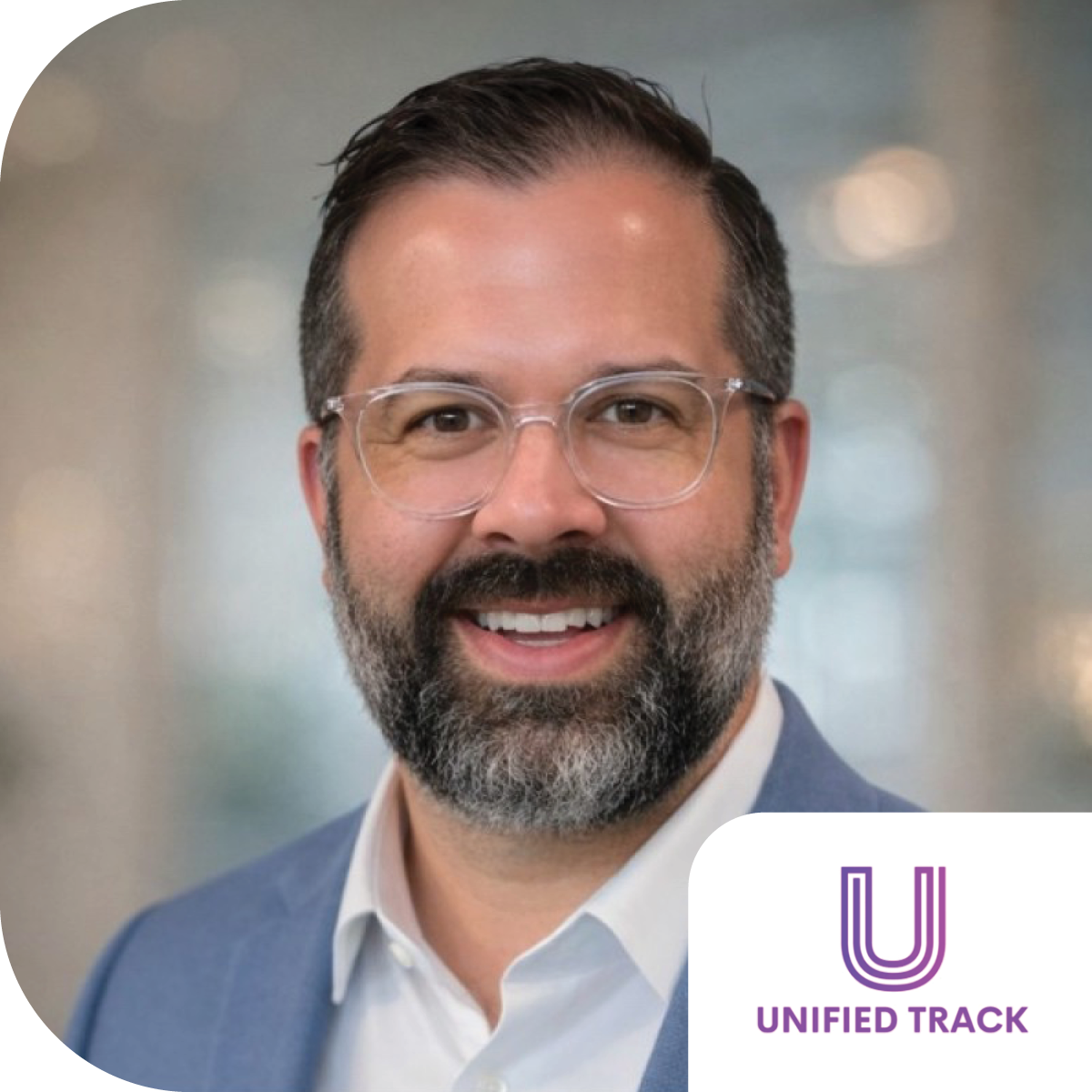
"I've cut my demos from essentially 45 minutes into 20 to 25 minutes, which allows me to do 2x and sometimes 3x more demos throughout the day...every week I was like, Rob, you know what I did? I went out there, and I'm driving top-line pipeline."
—Dustin Bainbridge, Founder and CEO, Unified Track
Kollegio: Finding the Niche Buyers with the PULL Framework
When Senan came into the program, he was pitching to any admissions officer who'd take a meeting. Some calls went weirdly well. Others went nowhere.
When we looked at the pattern, it wasn't random. Big schools weren’t the right market. Instead, small colleges and niche programs—the ones looking for very specific students on very tight budgets—were pulling. Their existing options (broad national campaigns, generic services) either didn't fit their budget or didn't have the targeting detail they needed.
Once Senan designed around the buyers with real pull, the close rate changed. The messaging got sharper. He stopped wasting time on calls that were never going to convert.

"I went into it skeptical. Within the first 10 minutes, Rob had me absolutely hooked…We keep growing month over month. We closed six deals in one month. Two weeks ago, we had the largest ever contract for $24K. Yesterday, we closed a new contract for $28K."
—Senan Khwaja, Co-Founder and CEO, Kollegio
2025 Catalyst Cohort Companies


FAQs
What is the Education Impact Fund
The Education Impact Fund (EIF) is a $250 million evergreen venture capital fund investing in early- and growth-stage companies that remove barriers to quality education and improve outcomes for underserved learners and workers. EIF Catalyst is our program for early-stage founders ready to build a scalable sales engine. Learn more about EIF. Learn more about EIF.
What's the weekly time commitment?
About two hours per week of scheduled sessions (group learning, 1:1s, call teardowns). Beyond that, you're doing what you should already be doing: running sales calls and working your pipeline. The program is designed to integrate into your selling motion, not sit on top of it.
How many companies are in each cohort?
We keep cohorts small—typically 5-7 companies—so every founder gets meaningful time with Rob and the group. We'd rather have fewer companies with real pull than a larger cohort where people get lost.
Does the founder have to attend?
Yes. The founder who leads sales must participate in all sessions. This isn't something you can delegate to a team member.
What if I have to miss a session?
Sessions are recorded. But the value is in live participation—the call teardowns, the real-time feedback, the peer learning. If you can't commit to showing up consistently, this isn't the right program for you.
Can co-founders both participate?
Yes, if you're both actively involved in sales. But one founder should be the primary participant who attends every session.
What happens after the 12 weeks?
You leave with a playbook, a refined sales process, and the skills to keep iterating. Many founders from Cohort 1 stay in touch with each other and with Rob. We're also exploring ways to support alumni—more on that soon.